
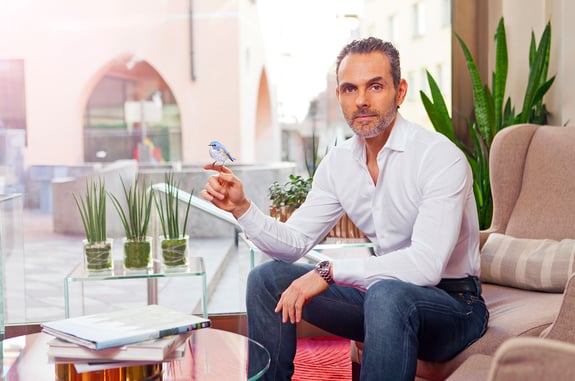
Carlo Fontana began working in the industry in 1990, within his family’s property in Lugano. At the time, PMS platforms and online reservations belonged more to the realm of speculation than of practice. “We wrote everything by hand in a notebook,” he recalls. The first management system, Fidelio PMS, arrived only in 1996. From that point onward, Fontana moved through each phase of the digital transformation of hospitality, from the introduction of Wi-Fi in the early 2000s to the adoption of iPads for housekeeping teams around 2010 to early check-in automation experiments already in 2008. His approach remains empirical rather than ideological, grounded in continuous iteration, testing, failure, and learning, always guided by a clear principle, simplifying the team's daily work while enhancing the guest experience.
Within the European hospitality landscape, few professionals embody the convergence of tradition and innovation as clearly as Carlo Fontana. Interviewed for the Resilient Tourism podcast by the EHL Hospitality Business School, Fontana reflects on more than three decades of lived experience, from handwritten check-ins to the introduction of artificial intelligence within the operational flows of his hotel. Yet this is not merely a chronological account of technological progress. It unfolds as a manifesto for a more conscious form of hospitality, where technology does not replace the human element but reinforces it.
An (un)intentional pioneer
Fontana entered the industry in 1990, working in his family’s property in Lugano. At the time, PMS systems and online reservations were closer to abstraction than to practice. “We wrote everything by hand in a notebook,” he recalls. The first management system, Fidelio PMS, arrived only in 1996. From that moment onward, his trajectory intersected with every phase of hotel digitalization, from the spread of Wi-Fi in the early 2000s to the introduction of iPads for housekeeping teams around 2010 to early check-in automation already in 2008. His approach remains empirical rather than ideological, rooted in iteration, testing, and the acceptance of error as a necessary condition of learning, always oriented by a stable compass, simplifying the team's work while enhancing the guest experience.
The “magic pyramid” of technology
According to Fontana, the issue does not reside in technology itself, but in the way it is introduced. To avoid strategic missteps, he proposes a hierarchical structure, a “magic pyramid” that should guide every digital decision.
- Leadership and a culture of hospitality - the guest at the center
- People – Attitude is required, not only competence.
- Processes – The organization must support attention to detail.
- Dati – Not only big data, but above all, small data: everyday micro interactions.
- Technology –Only at the bottom of the pyramid, as an enabling tool..
Reversing the order, starting from technology and hoping the rest will follow, leads, according to Carlo Fontana, to failure in the majority of technology implementation projects.
High-tech for low-stress
“For a smile, two seconds are enough,” Fontana observes. “But if you are busy dealing with a technical issue, that smile disappears.” The true function of technology in hospitality is therefore to liberate time, not to occupy it. Within this perspective, systems such as Hoxell are conceived to intercept the small failures, the micro glitches that punctuate service, and transform them into actionable data for continuous improvement. What emerges is a form of operational intelligence that begins with error and converts it into value.
The human at the center
“To welcome is the essence of hospitality. And this is done by people, not by machines.” This statement condenses the core of Fontana’s vision. Hospitality, in this sense, is grounded in attitude rather than automation. Relationships cannot be improvised, nor delegated. They must be cultivated, both internally among colleagues and externally with guests. “Treat your colleagues as you would treat a guest,” he suggests, recognizing that internal well-being is a prerequisite for authentic external experience.
Technology as philosophy, not software
One of the most significant aspects of his reflection concerns the nature of technology itself. It is not a tool, but an organizational philosophy. Collecting data has little value without a shared culture focused on guest attention. The real challenge lies in humanizing information, in giving meaning to detail, a preference for a specific side of the bed, a taste for carrot juice, without crossing the boundary of privacy, but instead strengthening the relational dimension.
Fontana’s lesson
Fontana’s approach carries an essential, almost radical clarity. It does not require choosing between technology and humanity, but constructing a conscious equilibrium between the two. The most effective technology is the one that disappears behind an authentic gesture. The future of hospitality will not be determined by those who accumulate more technology, but by those who understand how to use it to make both guests and employees more fully human.
Listen the episode here: https://open.spotify.com/episode/6AJkZLsoLAJCGJsXugFk02?si=qnVXf666TBqRwgCfPj9eNw