
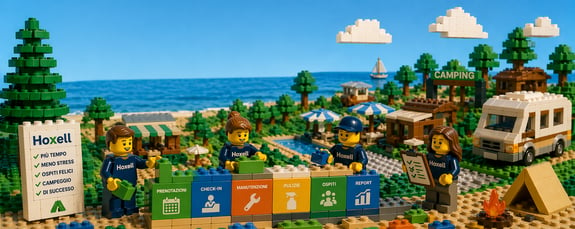
In the world of campsites, where everything is connected but often managed in a fragmented way, a more fluid and coordinated approach is needed. In this interview, Davide Bernasconi explains Hoxell starting from a simple metaphor: LEGO, where each piece only works if it fits together with the others. The result is a different way of organizing work—clearer, faster, and more human.
Davide, let’s start with a curiosity: is it true that you’re a LEGO enthusiast?
Absolutely. And it’s not just a childhood passion that stuck around over time. It’s a way of thinking. You can’t improvise: if one piece is out of place, the whole structure becomes unstable. That’s exactly what happens in a campsite. That’s why I often use this analogy when I talk about Hoxell—because LEGO explains better than a thousand slides what we mean by flexibility. Each brick has a specific function, but on its own it’s useless. Only when it connects with others does it create something meaningful. That’s how a campsite works too: reception, maintenance, housekeeping, entertainment, food service… everything is interconnected. If one piece is missing or out of place, the balance is broken.
And was Hoxell created precisely to prevent this?
Exactly. When I started coordinating the development of Hoxell, I had in mind a platform that wouldn’t disrupt operations but would fit seamlessly into each property's real workflows. Not just hotels, but also campsites, glamping sites, and resorts—very different realities, but with one thing in common: everyday complexity. The goal was (and still is) to simplify. Eliminate friction between departments, improve communication, and reduce chaos. In one word: fluidity.
Many campsite managers tell us that even today, operations still rely on printed sheets and phone calls. Is that the case?
Very often. Every morning, the printer starts churning out schedules, maintenance issues, arrivals, and departures. Then come the WhatsApp messages, the calls between reception and housekeeping, the rush to find someone. It’s a system that only works as long as everything runs smoothly. But all it takes is a sudden rainstorm or a guest changing pitch at the last minute, and the balance falls apart. Hoxell is designed to restore control—and peace of mind.
How?
By connecting in real time, the people working on the ground: reception staff, maintenance technicians, housekeeping, and department managers. Everyone sees only the information that matters, exactly when they need it. No more notes, phone calls, or walkie-talkies. The interface is so intuitive that even those who have never used a tablet can feel comfortable within half an hour. Our goal is not to complicate jobs, but to make them more effective.
And what about integration with the campsite’s other management systems?
It’s crucial. Hoxell integrates with the main systems designed for the open-air sector, enabling real-time synchronization of operational workflows. When a guest leaves a pitch or a mobile home, the status is updated instantly, triggering cleaning, maintenance, or quality control tasks and assigning them to the right person with the correct information. This means fewer errors, less waiting, and greater efficiency. Every operation is tracked—not to exert control, but to better understand day-to-day operations, identify areas for improvement, and make more informed decisions.
You often talk about microdata. What does that mean in practice?
It means moving from gut-based management to informed management. You don’t need abstract big data—you need operational data: knowing that pitches near the restrooms require more cleaning, or that on Saturdays you need two more maintenance technicians. We are already integrating predictive systems that help plan more intelligently. But the final decision always remains with people—that’s the core of our human-in-the-loop approach.
What impact does all this have on organizational culture?
Profoundly. Hoxell is not just software, but a different way of experiencing day-to-day operations. Those who adopt it don’t go back—in fact, they often request it in new properties as well. It changes how work is perceived: more collaboration, less stress, more time for what really matters. This also applies beyond (more or less) traditional hospitality. In a hospital, for example, it has improved response times and operational safety. Same principles, same benefits.
And the campsite? How does it change in practical terms?
It becomes more fluid, more seamless. More human, paradoxically. Because when every department is aligned, every task is tracked, and every piece of information is shared, people can focus on what truly makes the difference: the guest. A returning guest recognized, an issue resolved before it’s even reported, a pitch prepared exactly as requested. That’s what makes a stay memorable.
In short?
Hoxell is like a LEGO set for your campsite: flexible, modular, and solid. It helps you bring order to disorder without disrupting what already works. But above all, it reminds you of one essential thing: in open-air hospitality, there are no minor roles. Every person is a vital node in the network. And when everything fits together, the guest experience becomes truly unforgettable.