
During the afternoon session of Hospitality Day, in the Sala del Lavatoio at the Palacongressi di Rimini, Davide Bernasconi took the stage to address a question facing every hotel in Italy: what happens to hospitality when the people who make it possible become increasingly difficult to find?
Thirty minutes dedicated to a clear vision: technology that works alongside hotel staff like a trusted colleague, with the same attention to the right moment, the right person, and the information that truly matters.
"What happens to hospitality when the people who make it possible become increasingly difficult to find?"
An Industry Operating with Half Its Workforce
The starting point is a single figure. In Italian hotels, 47.5% of positions remain unfilled: “We are unable to find and replace almost one in two employees,” Bernasconi pointed out. Staff shortages have long ceased to be a temporary consequence of the pandemic and have become an everyday reality that hotel managers, executive housekeepers, and department heads must deal with when organizing each shift.
Those who remain on duty take on the workload of missing colleagues, constantly juggling urgent tasks, maintenance issues, and immediate requests, leaving less and less time to dedicate to guests.
The principle of “doing more with less,” interpreted as five people being expected to do the work of ten, leads to stress, exhaustion, and a decline in service quality precisely where guests notice it most.
"The principle of “doing more with less,” interpreted as five people being expected to do the work of ten, leads to stress, exhaustion, and a decline in service quality precisely where guests notice it most."
There is also a less visible, yet equally tangible cost. Every employee who leaves a hotel takes part of its operational knowledge with them: the room with the window that gets stuck, the regular guest who always requests the same room arrangement, the system that needs to be checked after every storm.
Bernasconi mentioned the example of qualified chefs who have chosen to pursue entirely different careers.
When this knowledge exists only in people’s minds, the hotel loses it when they leave. When it is captured and shared through a platform, it stays within the property and becomes a valuable asset for the entire team.
"Every employee who leaves the hotel takes part of its operational knowledge with them."
The Colleague Who Speaks Up at the Right Moment
This is where the title of the presentation comes from. For Hoxell customers, the platform has already evolved into something more than software: according to surveys conducted between 2025 and 2026, 98% of respondents describe it as a partner, an operational colleague who supports them throughout their working day.
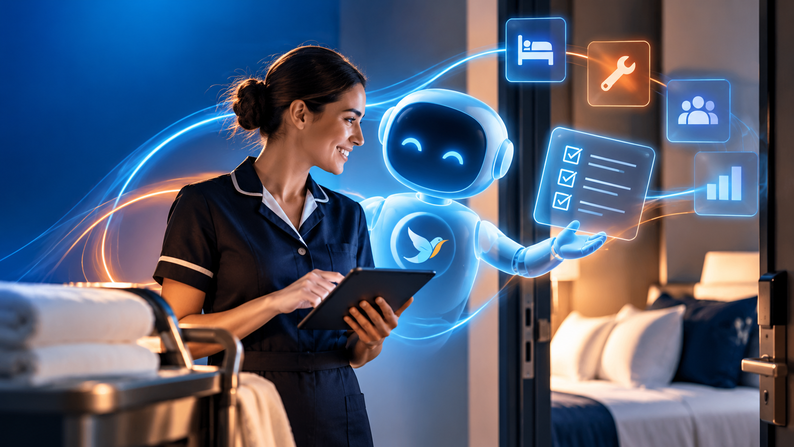
Bernasconi was quick to clarify the thinking behind this definition, emphasizing that he would be the last person to advocate a future in which artificial intelligence replaces people. The role of a digital colleague is quite different, and he summed it up in a simple statement: “A good colleague is someone who reaches out to me and involves me at exactly the right moment.”
In a hotel, this means that a room becomes visible as ready on the front desk’s device as soon as the housekeeper marks it as completed; that a maintenance issue is automatically directed to the person responsible for fixing it; and that a reported problem becomes a trackable task, with an outcome visible to everyone involved.
Phone calls between housekeeping and reception, radio communications, and word-of-mouth exchanges in the corridors give way to a structured flow of information, where each department sees what is relevant to its work and responsibilities remain clear and shared.
“We have eliminated that background noise,” Bernasconi explained, “and given people the time they need to truly pay attention.”
"Abbiamo tolto il rumore di fondo e dato alle persone il tempo necessario per prestare attenzione."
The figures collected from properties using Hoxell demonstrate just how much time has been given back to hotel staff: a 40% increase in operational efficiency, a 75% reduction in internal phone calls, and a 30% decrease in guest complaints.
Considering that a single operational phone call takes approximately 30 seconds on average, in a 100-room hotel, that 75% reduction translates into hours of working time saved every month, allowing staff to focus on what truly matters.
Quality Managed in Real Time
The reduction in guest complaints reflects a fundamental shift in how service quality is monitored and maintained. Traditional inspections, carried out weekly or monthly, only capture the situation after guests have already experienced a service issue. With a digital colleague monitoring daily operations, anomalies are detected as they occur, allowing the team to intervene before they affect the guest experience.
The example Bernasconi chose is deliberately simple and familiar: a room where light bulbs need to be replaced several times within a few weeks. Each intervention, considered individually, appears to be routine maintenance. However, when analyzed together, these signals point to an underlying electrical issue. The platform recognizes this pattern and recommends a more comprehensive intervention to address the root cause.
This is predictive maintenance in its most practical form: lower costs, fewer repeated technician visits, and less disruption for guests.
The Intelligence Behind the Data
All of this, Bernasconi emphasized, depends on one essential condition: “Artificial intelligence only works when the data behind it is intelligent.”
Clean, accurately entered data, a platform used consistently every day, and a system configured around the property’s specific operational processes are all essential. This includes defining standard cleaning times, such as twenty minutes for a stayover room and forty minutes for a checkout room.
Even a task that has been started but remains unfinished provides valuable information, as it reveals where operational workflows encounter delays or bottlenecks.
"Even a task that has been started but remains unfinished provides valuable information, as it reveals where the workflow encounters bottlenecks."
At the heart of the presentation is the distinction between big data and microdata. The former, including benchmarks and market data, can be purchased from external sources. The latter is generated within the hotel itself and reflects what actually happens on the property: timings, operational dynamics, anomalies, completed tasks, and pending activities.
“The most important data, the data that no one can buy, belongs exclusively to you: it is what we call microdata, the information generated by everything that happens within your property.”
It is microdata that makes reports and dashboards truly reliable, providing an accurate picture of what is happening in that specific hotel on that particular day.
“The most valuable data, which no one can buy, belongs exclusively to you: it is what we call microdata, the information generated by everything that happens within your property.”
Understanding Guests in Context
The same principle applies to hotel guests. PMS and CRM systems remain essential tools, but Bernasconi suggested complementing them with a data-driven approach that always considers the context of each individual stay.
The same person spending a week skiing alone in Sestriere has very different needs when returning to Puglia in the summer with their family. Their preferred room temperature, turndown service arrangements, and daily routines may all change.
“We put people at the center,” he explained, “because we need to adapt that data to the specific context in which each person finds themselves at that particular moment.”
Microdata makes it possible to translate this level of attention into precise operational instructions for each hotel department.
"We put people at the center because we need to adapt that data to the specific context each person finds themselves in at that moment."
AI Agents Supporting Hotel Managers and Executive Housekeepers
The next step in this evolution is the introduction of artificial intelligence agents. The platform analyzes information before the hotel manager even opens their dashboard, presenting a clear overview of the day, with issues already prioritized by severity and urgency, along with practical recommendations on where action is needed.
For executive housekeepers, daily room assignments take into account each employee’s skills, existing workloads, and the specific operational requirements of the day, moving beyond the traditional fixed-credit system.
Bernasconi described this evolution as an extension of Business Intelligence into actionable operations. Housekeeping teams need support that can analyze data in real time, identify anomalies, suggest priorities and schedules, and help prevent service disruptions, while always working alongside people.
Hoxell has focused its development on AI agents specialized in executing and optimizing processes, designed specifically around the operational realities of hotel departments. This is where the Digital Worker takes shape.
A New Identity with Data at Its Core
The presentation concluded with the unveiling of Hoxell’s new brand identity, introduced in Rimini during the same week as TTG Travel Experience.
In the new logo, the iconic bird is now integrated into the “O”, symbolizing the central role of data and Operations in everything the platform does.
The tagline evolves from “Excellence in hospitality” to “Clarity in operation”, a statement that reflects Hoxell’s focus on microdata, its agentic approach to AI, and the clarity it brings to the daily processes of hospitality professionals.
Hospitality Belongs to People
The closing message brought the discussion back to where it began.
“Let’s leave hospitality to people,” Bernasconi said.
Technology should take care of everything that staff shortages make increasingly difficult to manage: analysis, organization, monitoring, prevention, and repetitive communication between departments.
A digital colleague that takes on these responsibilities gives hotel staff back their time and attention, allowing every property to focus on what truly matters: welcoming guests, caring for them, and building meaningful relationships.
"Let people take care of hospitality. Technology should handle everything that staff shortages make increasingly difficult to manage"